


Blog

What Can A CFO Do For You?

Posted by Keith Huggett on Tue, May 28, 2013 @ 09:05 AM

Even Small Businesses Can Have Large Business Financial Issues

cfo servicesAuthor: Keith Huggett 

Large businesses have it all: large accounts, both income and expense, customers coming and going, and financial issues and the staff to handle them.  The same things occur with smaller businesses too. Small businesses have large accounts, both income and expense, customers coming and going and financial issues.  What smaller businesses may not have is the staff to handle those issues.  In a small business, there is usually the business owner who is in charge of running everything and some things can fall by the wayside.  There comes a time for a small business to consider getting some help.  Hiring a full-time CFO may not be an option, for many reasons, one of which may be cost, or there may not be the need for a full time CFO. Luckily for the small business owner there is the option of outsourcing CFO services, or hiring a part-time CFO.

Reasons to Consider a CFO:

Experience: A CFO brings years of financial experience to your company. An experienced CFO  will go beyond the numbers and get involved in all aspects of your operations. He can be a sounding board for key business decisions and identify opportunities for improvement.

Business Analysis: Like all companies you will need to analyze your business performance on a regular basis.  Unless you have spent what little spare time you have at business school learning the latest in Finance 101 or have taken the time to study business books, like most business owners, you haven't been trained in developing and using financial information and have little time left over from running the day to day operations of your business. Having a financial expert review, analyze, and summarize the financial data into meaningful reports can add tremendous value.

Competition: Most small business owners do not have the time or access to compare their operations to similar companies. A CFO can set up reports and gain access to data to compare the business to other comparable companies.

Resources: A CFO is a prime resource for training, developing and supervising your staff. As your organization grows the CFO can help you develop and implement processes and controls that protect your companies assets.

All in all, outsourcing or hiring a part-time CFO allows you to tap into the wealth of experience and knowledge at a fraction of the cost of hiring a full-time CFO.  You are then able to focus on growing and building your business knowing that an experienced professional is watching over the company's financial resources and performance.

The professionals at The Tax Office, Inc. are pleased to announce their newest division, Client Accounting Services (CAS), which include CFO Plus services, CFO services, Controller, Accounting Manager, Bookkeeping, and Payroll Packages. Contact Us to learn more.

Topics: Keith Huggett, CFO services, business services

Natural Disasters and Charitable Donations

Posted by Keith Huggett on Wed, May 22, 2013 @ 09:05 AM

Helping Others During A Trying Time

natural disasters charitable donationAuthor: Keith Huggett 

Between fires, floods, hurricanes and tornados, since 2005 the United States has been wracked over and over by Mother Nature. First it was Katrina, then Rita came rushing in hot on Katrina's heels to decimate Louisiana. In 2007, wildfires burned their way across Southern California, destroying 1500 homes and over 500,000 acres of land. In 2008, Hurricane Ike blew through Texas, Louisiana, and Arkansas, leaving a wake of damage estimated to be around $19 billion. In 2011, 358 tornados spread throughout 21 states from Texas to New York from April 25 through April 28. This outbreak was the costliest tornado outbreak and one of the costliest natural disasters in United States history, with a total of $11 billion in damages. 2012 brought us Hurricane Sandy. Hurricane Sandy affected 24 states, including the entire eastern seaboard from Florida to Maine and west across to Michigan and Wisconsin, with particularly severe damage in New Jersey and New York. Damage in the US is estimated at over $71 billion. Now, in 2013, we have the tornados that struck Oklahoma wreaking massive devastation, and hurricane season not yet upon us.

With FEMA and the American Red Cross hard at work setting up shelters for the displaced families in Oklahoma one might feel inclined to make a charitable donation to one of the organizations that helps out in times like these. For a list of major nonprofits that provide assistance to communities impacted by disaster, visit the National Voluntary Organizations Active in Disaster website. By doing a "good turn" as the Girl Scouts say, a good turn is brought back to you. By making a charitable donation, you get a tax deduction.

  • The American Red Cross of Oklahoma City offers several ways to help, online or by phone. Sending a text to 90999 with the message REDCROSS will result in a $10 donation.
  • The Red Cross also has a "Safe and Well" service that allows survivors to register themselves online and lets family members check on the status of loved ones.

 Think of those people in Oklahoma, currently taking stock of their lives. Natural disasters can occur anywhere. Are you prepared should a disaster occur where you live. Here in California it could be a fire or an earthquake. Do you have a plan in place? http://www.ready.gov/make-a-plan has helpful information for making an emergency preparedness plan.

The Tax Office, Inc, is not affiliated with FEMA or the Red Cross or any donation sites. We suggest that you investigate any site before you make a donation to be certain it is an authentic charity. If you have any questions regarding making a donation, please contact us. We would be happy to answer any question you might have. We can also be reached on Twitter at #plan4tax. 

Our condolences and best wishes go to the residents of Moore, Oklahoma.

Topics: Keith Huggett, Charitable donations

Be Aware of False Corporate Communications

Posted by Keith Huggett on Tue, May 21, 2013 @ 09:05 AM

Watch Your Mail for Advertisements From False Government Departments

false advertisement corporate documentsAuthor: Keith Huggett 

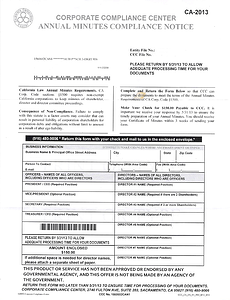
Once you've filed the documents required to operate your corporation, you are required to file a few more. There are quite a few forms you need to have to fill out your Corporate Book, however that's not really what we're talking about today. Today, it's about shady advertising. There are companies that would be happy to provide Annual Minutes, Bylaws, or other Coporate Documents to you by hiding behind an advertisement that makes them look like a very official Government Agency.

You will receive in the mail a document, or many documents, that look very official, and like they come from a Government Agency. If you look VERY, VERY closely, you will see at the bottom, in very small print the disclaimer, stating that the company is not affiliated with any government service. This document implies that your company is either out of compliance or soon will be and that you *need* to use this service to become compliant again. They send this form for Corporate Minutes, Annual Meetings, and Bylaws. These companies are NOT affilitated with any government service at all and are merely sending you advertisements. You do not need to respond to them in any way. 

For information on corporate documentation and compliance, please download our whitepaper "Staying Compliant in a Corporate World." If you have questions about your business structure, our specialists at the Tax Office, Inc. would be happy to take your call.  We can help you with your Corporation documentation should you need any assistance.  We are always available to speak with you whenever you'd like to talk, whether it's regarding taxes, bookkeeping, payroll, or the weather. Give us a call. We'd love to hear from you. You can even ask us questions on Twitter at #plan4tax - We hope to hear from you.


Topics: Keith Huggett, tax scams

Your Startup Business: Is It Safe To Quit Your Day Job?

Posted by Keith Huggett on Thu, May 16, 2013 @ 10:05 AM

Small Business Owners Need to Be Aware of Financial Situation

small business

Author: Keith Huggett

Launching a startup business is exciting, but you can't ignore the practical realities of your personal finances. If you're one of the many people who created a startup business while being employed by another company, you will likely experience a point when you need to decide whether to stay with your day job, or quit and pour all of your energies into your own business. This is a difficult decision. You can't effectively run your startup with the limited time that you have, but you're not sure if it will be successful quickly enough to sustain your financial requirements.

So how do you know when it's time to take the plunge? First, get the following ducks in a row to protect your own financial health:

  • Save up for a long haul: Pay down as much debt as you can and save enough money to sustain your lifestyle for at least six months. Separate your personal money and the funds you plan to dedicate to your startup business so you don't face any unpleasant financial surprises down the road.
  • Have a solid plan: While you may have fully thought through your business idea, if you don't have a plan to follow it's easy to get distracted along the way. You may be able to afford these distractions now, but this won't be the case if you give up your primary income source.
  • Consider factors other than money: What will you do for health coverage? Do your kids currently participate in a daycare program through your current employer? Are there other perks that you currently take for granted that will impact your lifestyle or finances?
Remember, starting a business often requires more money than you may expect. Be sure that you have enough startup capital to cover unexpected situations.

To make sure you have the full financial picture of your startup business, consider working with a qualified tax professional like those at The Tax Office Inc. We can help you evaluate your current financial situation and the various consequences of striking out on your own. Contact us today to learn more, or schedule a meeting online. For quick answers to your questions, find us on Twitter at #Plan4Tax.

Topics: Keith Huggett, startup business, business services

The Affordable Care Act & Your Business

Posted by Keith Huggett on Tue, May 14, 2013 @ 13:05 PM

Does it Affect Me?

affordable care actAuthor: Keith Huggett 

The Affordable Care Act is going to affect everyone in some way. Does it affect you? The ultimate answer to that question is yes. Is it going to affect your business? It depends. What does it depend on? The answer to that quite honestly is the number of full time equivalent employees you have. A full time employee is any employee who works 30 hours a week or more. Seasonal employees become full time employees after 120 days. 2013 is the base year for determining the employee count for 2014.

The important number for you to consider as a business revolves around the number of employees you have. Do you have more than 50 employees? If not, than the healthcare act is not a factor for you. If you do not have more than 50 employees you are exempt from the fines attached to the healthcare act. Businesses that do not offer their employees health insurance will be fined $2000 for every full time employee that received a government subsidy for purchasing coverage through an exchange, excluding the first 30 employees.

For a more in depth look at the Affordable Care Act, please download our white paper, Healthcare Answers for Today's Questions on our website. 

Should you have any questions regarding the Affordable Care Act, and it's affect on your business, please contact us. The Tax Office, Inc. and it's team of specialists are here to answer your questions.

Topics: Keith Huggett, affordable care act

Choosing A Tax-Efficient Business Structure That Fits

Posted by Keith Huggett on Thu, May 9, 2013 @ 09:05 AM

Incorporation Proves Beneficial to Businesses

Author: Keith Huggett

incorporating a businessIncorporating your business not only lends credibility to it, but also builds in protection for your personal assets. Without the virtual shelter of incorporation, you could lose your home and other personal property if someone sues your company.

But which tax-efficient business structure (incorporation option) is best for your business? It depends on the size of your company and additional factors. Here are some of your choices and some general guidelines:

  • C corporations – C corporations are appropriate for large companies that have more than $10 million in assets and file more than 249 returns with the IRS annually. These include the Form 1120 corporate return, 1120-W estimated tax returns and employment/unemployment  tax returns.

  • S corporations – S corporations have fewer than 101 shareholders; these must be individuals or certain estates and trusts that function as individuals. Such corporations allow shareholders to pass income and losses through to their personal returns, which lets shareholders avoid the double taxation that can occur with C corporations.

  • Limited Liability Companies (LLC) – LLCs are becoming more popular because of their simplicity. They grant the owners of the business personal asset protection, but individuals can choose to file personal returns instead of corporate ones. Small business partnerships and single-owner small businesses typically find that an LLC is the most tax-efficient business structure for their needs. Still, it depends on your local state laws and type of business. For example, insurance companies and banks cannot form LLCs.

This is a critical decision, one that will have great impact on the future of your company. So you must choose wisely. At The Tax Office, we specialize in helping you choose a tax-efficient business structure that meets your unique needs.

We also offer tax preparation, planning, representation, online bookkeeping and complete accounting services for you and your business. We will listen to you and help you determine the best ways to grow.

Contact us today to see how we can help you put the pieces of your company's financial puzzle together.

Topics: Keith Huggett, business structures, corporations

Has Your Business Outgrown Sole Proprietorship?

Posted by Keith Huggett on Wed, May 8, 2013 @ 11:05 AM

Businesses May Need Change of Structure

Author: Keith Huggett

business structureSo you’ve been operating your business as a sole proprietorship for a while, perhaps even several years, but now you’re wondering if you’ve outgrown this arrangement.

It’s not uncommon for sole proprietors to convert to another business structure as their business grows and needs change.

Your sole proprietorship was easy to set up, and you’re beholden to no one because your business isn’t really a legal entity. On the other hand, you’re personally liable for the whole thing, so your assets are at risk. You have to pay self-employment tax on your profits. And, technically, you have no business to pass along or sell if you die or want to move on.

Now you need additional expertise to develop products or manage the company, or you need more capital to expand. Bringing on one or more partners or becoming a corporation may be the answer. Or maybe you want to reduce your level of risk and you’d feel better-protected by becoming a limited liability company (LLC).

In essence, options other than sole proprietorship include:

  • A general partnership. Partners share the burden and the wealth, but a formal agreement is essential.
  • A limited liability company (LLC), also easy and flexible. You get the liability protection of a corporation, but you can sidestep onerous procedural requirements.
  • A corporation, which offers clear separation of personal assets, tax savings, and the best opportunities for outside investment. But you’ll face lots of formal procedures and reporting.

Whatever you choose, there will be plenty of paperwork involved. And of course there are some costs. But those are temporary – think of them as growing pains.

Is this the right time to switch your business structure?

It’s the perfect time to consult a tax professional. Here at The Tax Office Inc., we understand the nuances of all business types as well as the ramifications for your specific business, so we can help you carefully evaluate the pros and cons of moving beyond a sole proprietorship.

If you’re seriously considering a change, contact us today and let us help you make the right decision.

Topics: Keith Huggett, business structures, sole proprietorship

Is Your Corporation Staying Compliant?

Posted by Keith Huggett on Thu, May 2, 2013 @ 12:05 PM

Compliance Issues You May Not Know About...

corporate complianceAuthor: Keith Huggett 

You may have noticed that I have been writing quite a bit about corporations and compliance lately. There is a reason for it.  Many a corporation have fallen under the watchful eye of the IRS for not keeping compliant. You may be unaware of some issues that come under their purvue.  So, here we are, letting you know about them.

As a corporation there are many things that you have to decide initially. Which business structure is the right one for you? Having made that choice, have you gathered all of the correct paperwork for your corporation together and formed your Corporate Book? Have you issued your stock? Have you set up your payroll? Did you set it up correctly so that payroll taxes do not become an issue for you later? Payroll is a very large issue that can haunt you in the future. It is wise to consult your tax professional about setting up a payroll service to handle this for you so that your payroll taxes are taken care of.

To answer all of these questions and more, our business specialists have put together an informational white paper, entitled "Staying Compliant in a Corporate World."  It will answer questions about payroll, "reasonable compensation," business entities, and much more.

For questions regarding corporations or other business services, please contact The Tax Office, Inc. at (916) 773-7053(916) 773-7053.

Topics: Keith Huggett, corporate compliance

Business Incorporation: You've Filed The Papers -- What's Next?

Posted by Keith Huggett on Tue, Apr 30, 2013 @ 09:04 AM

Incorporation Only the Beginning

Author: Keith Huggett

business incorporationBusiness incorporation is just the first step to starting a successful company. Now that you have reached that important milestone, you have a long and (hopefully) profitable road ahead. Follow these tips to keep your operations running as smoothly as possible from day one:

  • Don't reinvent the wheel: Thousands of entrepreneurs before you have already made the mistakes that you can seek to avoid by educating yourself. Network with other business owners in your area, participate in online forums relevant to your industry and do thorough research before you take any major steps.

  • Consult a tax professional early: Business taxes are different from personal taxes and you can avoid costly mistakes by engaging a tax professional as soon as you start your business. If you wait until the end of the year, you may discover that you missed quarterly filing or payment requirements, which can result in penalties that will cost you a lot more than compliance.

  • Understand your customers: Find out what your customers value most and give it to them. Remember that it may not be what you most expect. If you offer a similar product or service to your competitors, you may stand out from the crowd by a offering better customer service experience or providing free consultations. If you're not sure what makes your customers tick, ask them directly or observe your competitors' successful activities and improve upon them.

  • Consider outsourcing: Business incorporation is relatively simple compared to actually running your business. Focus on your core strengths and consider outsourcing administrative tasks such as payroll and bookkeeping to a qualified provider. You'll be able to spend more time on growing your business, and you won't make many of the tax and accounting mistakes that often cost new business owners a lot of money. 

The Tax Office Inc. team has decades of experience with helping small businesses with tax planning, tax preparation, bookkeeping and other accounting services. Contact us today to learn more about how we can help you after business incorporation. We can also help you incorporate your business if you haven't yet completed that crucial step.  "Staying Compliant in a Corporate World," an informational white paper can provide anwers for your corporate compliance questions.

Topics: Keith Huggett, business structures, corporations

Audit Defense Plan - Are You Covered?

Posted by Keith Huggett on Thu, Apr 25, 2013 @ 09:04 AM

Do You Have Audit Insurance?

audit defenseAuthor: Keith Huggett 

You might not think this is a serious topic, but it really is. If you do not have audit insurance you should probably purchase some. According to Accounting Today, despite cuts to personnel and their budget, the IRS has increased the number of audits performed by 20% since 2009. An audit defense plan can be bought as part of your tax or business package, or it can be bought as a single item. If you get audited and you do not have an audit defense plan in action, the costs of dealing with the IRS or State Agency are going to quadruple, and I'm not only talking about monetary costs. Without an audit defense plan, you have to deal with the stress and anxiety of dealing with the IRS all on your own, which is something you really do not want to do. It is so much better for you to let a tax professional help you. It's our job and we can make the process much smoother for you.

An audit defense plan covers you on a month to month, or annual basis from the time you purchase the plan, until you stop service, depending on where or with whom you get the plan. It is very similar to any other insurance plan.  You are provided with service, should you be audited, while covered. Should you stop payment on your plan, your coverage ceases along with your audit protection.

While you are covered, if you receive any government notice regarding your income tax return you will have the safety and security of knowing that you are protected by a qualified, experienced professional who will fight your battles with the IRS or State agency. This means that when you get that letter, you just send it to your tax professional and they should handle it. Your tax agency should also represent you in either a correspondence, field, or office audit by any government agency with no additional fees.  If your audit goes to appeals there may be some additional fees. 

You should be aware that not all tax offices offer their audit defense plans in this manner and their terms may be different.  At The Tax Office, Inc., we offer our audit defense plans in conjunction with our business and tax packages. Please contact us with any questions you may have about our audit defense plan. We also provide helpful information on our website for when and if you receive that notice of audit for your personal or business return.

Topics: Keith Huggett, audit, audit defense