


Blog

Tax Scams On The Rise

Posted by Jenny Shilling on Thu, Aug 28, 2014 @ 07:08 AM

Beware of Imitation IRS Agents

tax scamAuthor: Jenny Shilling

Have you recently received a telephone call from someone claiming to be from the IRS?  Chances are it's a scam.  Con artists are using the telephone to demand money from unsuspecting people by claiming they are from the IRS.

The fake IRS representatives tell the person who answer the phone that if they don't pay up immediately, they could have their driver's license revoked or even face jail time. With this type of threat looming, a lot of people act out of fear and comply with this demand.

Through mid-August, the Treasury Inspector General for Tax Administration, or TIGTA, has received around 90,000 complaints about the scam-IRS calls via its own telephone hotline. More than 1,000 of those who were contacted believed the con artists and handed over an estimated $5 million, according to the IRS.

To avoid becoming a victim of these scams, you should know:

  • The IRS will first contact you by mail if you owe taxes, not by phone.
  • The IRS never asks for credit, debit or prepaid card information over the phone.
  • The IRS never insists that you use a specific payment method to pay your tax.
  • The IRS never requests immediate payment over the telephone.
  • The IRS will always treat you professionally and courteously.

If you get a phone call from someone claiming to be from the IRS, here’s what you should do:

  • If you know you owe taxes or you think you might owe taxes, call the IRS at 800-829-1040. IRS employees can help you with a payment issue if you owe taxes.
  • If you know you don’t owe taxes or don’t think that you owe any taxes, then call and report the incident to TIGTA at 800-366-4484.
  • If cons have tried this scam on you, you should also contact the Federal Trade Commission and use their “Complaint Assistant” at FTC.gov. Please add "IRS Telephone Scam" to the comments of your complaint.



Topics: Jenny Shilling, tax scams

Tips for Reconciling Your Accounts

Posted by Keith Huggett on Tue, Aug 26, 2014 @ 07:08 AM

Keeping Up Can Help You Spot Errors

reconciling accountsAuthor: Keith Huggett

Have you ever wondered why reconciling your bank accounts is so important? By reviewing your transactions in your bookkeeping software, QuickBooks, Intaact, Xero, and comparing them to your bank statements and/or credit card statements, you are able to make certain that all of your transactions are accounted for so that everything matches and is accurate. Reconciling your accounts should be a monthly process, allowing you and your books to stay up to date.

To simplify the reconciliation process, keep these tips in mind:

  • Match the beginning balance in your software to your statement's beginning balance. It is important that these two figures match. If there is a discrepancy, contact your bookkeeper and ask why.
  • Keep it simple. Once you have your beginning balance input, move forward by inputting the ending date, ending balance, and any interest income or charges. Now it's just a matter of checking off those transactions that are matched with your software and bank account.
  • Make sure you are recoding your transactions in the correct place.  Using the correct income and expense account is critical.
  • Should trouble arise during your reconciliation, either make posts to the "Ask My Accountant" or contact your bookkeeper directly. 
  • Use your software's report function.  Print out and save a copy of your reconciliation report.
If you need assistance with reconciling your accounts, contact us, The Tax Office, Inc.  Our experienced and qualified bookkeepers would enjoy handling your reconciling for you.

Topics: Keith Huggett, bookkeeping, reconciling accounts

Tax Tips for Renting Out Your Vacation Home

Posted by Keith Huggett on Thu, Aug 21, 2014 @ 09:08 AM

What to do with your Vacation Home after Vacation

vacation rentalsAuthor: Keith Huggett

Vacation time is over and your family is getting ready to return to life in the faster lane.  What do you do with your vacation home? Will you close it up for the rest of the year? Will you rent it out so that others may benefit?  If you choose to rent out your vacation home, there can be tax implications.

Rental Income - Rental income in general is taxable.  If you rent out your vacation home for less than 14 days, the income is tax free.  If your renter stays more than 14 days you need to report the income on your tax return. You can deduct rental expenses, but your deductions are limited because the amount of expenses you can deduct depends on whether the property is a business or a personal residence in the eyes of the IRS. The IRS determines this by calculating the proportion of personal use to the amount of time you rent the property.  If you use your vacation property for less than 14 days or less than 10% of the time you rent the property, the IRS classifies your rental as a business.  If you use your property for longer than the 14 days or 10% of the time it is rented, the IRS will classify your rental as a personal residence.

Deductions - Renting out your property will also incurr some expenses.  Depending upon how the IRS classifies your property will define what you can claim as a deduction. If classified as a business, you have to apportion eligible deductible expenses (i.e., cleaning, repairs, utilities) according to the amount of personal or rental usage. To determine the percentage of expenses you can deduct, divide the number of days rented by the total number of days of used (personal days plus rental days). Once you have that, your expenses can be itemized on your tax return.

If your rental is classified as a personal residence, you are able to deduct things like property tax and mortgage interest along with the itemized expenses.

Record Keeping -  As always, it is important to keep accurate, detailed records.  Items you will want to keep include receipts and invoices, mortgage statements and the like. Keeping a record of all improvements and repairs made to the rental is also of high importance. Having a separate checking account especially for the rental property can make documenting your rental expenses easier.

Audit Proofing Your Rental - Always treat your rental as a business. To keep the IRS uninterested in you, you need to make sure that you look like a business. Keep clean books, have separate bank accounts, and make sure you keep accurate records of repairs. Keep those receipts.  “Audit-proof” your rental property just as you would “baby-proof” your home, it just might keep both you and your property a little bit safer.

If you have any questions regarding renting out your rental property, please contact us.  The specialists at The Tax Office, Inc., can provide you with answers, show you what deductions are available to you and much more.

Topics: Keith Huggett, tax deductions, real estate

Summertime Jobs, Teenagers, & Taxes

Posted by Jenny Shilling on Tue, Aug 19, 2014 @ 09:08 AM

Will your Teen's Summer Job Affect Your Taxes?

summer jobs, taxesAuthor: Jenny Shilling

Summer is almost over, and with its end comes the end of summer jobs.  Having received paychecks for the first time was probably very exciting for your teen, until he or she learned just how much they would have to pay in taxes.  How much did your teen earn? Does the summer employment affect whether or not you can claim your teen as a dependent? Are there any child related tax credits you might lose because of their employment?

Many things change when your children start working. Let's look at the tax impact since those are clearer and certainly more readily explainable than other changes with our teenagers.

  1. Filing Requirments. There is a minimum filing requirement. Dependent children have to file a tax return if they earned income of more than $6,200.  There are also other filing requirements based on gross income, which include items such as dividends and interest.
  2. Do I claim their income? Your teen is required to file his or her own taxes if the child is working or receiving income other than interest and dividends.
  3. Teens Owing Taxes? A good rule of thumb for your working child is to claim zero exemptions on their W-4 to ensure they have enough taxes withheld so they don't owe money to the IRS come tax time.
  4. Still a Dependent? Your dependent child can have any amount of income and still be claimed as a dependent as long as they do not provide more than half their own support: gifts, entertainment, food, shelter, clothing, purchasing a vehicle, maintaining a vehicle, other forms of transportation and school expenses.  If your child can be claimed as a dependent on your tax return, they cannot claim their own exemption.
  5. Child Tax Credit? Each dependent child under the age of 17 can qualify you for the $1,000 per child tax credit. The credit is available to you even if your child is working and paying taxes on their income.
Having a working child can impact your tax return. It is important to know what impacts your child's  income has on your tax situation. Be sure to consider the tax impact of your child working a summer job - every summer. It could cause an underpayment of taxes by either you or your child or a lost refund if the return isn't filed.

For questions regarding your tax return, or your child filing for the first time, please contact a qualified tax professional.  The specialists at The Tax Office, Inc., are availble to field your questions.  Contact us for a no cost, no obligation discussion of your tax situation.


Topics: tax deductions, Jenny Shilling

Marital Status & Your Taxes

Posted by Jenny Shilling on Thu, Aug 14, 2014 @ 13:08 PM

Married Filing Joint or Married Filing Separately - Which is the Best Choice?

married filing joint, married filing singleAuthor: Jenny Shilling

The federal tax code, as you may know, gives benefits to those who file as "Married Filing Joint."  With the recent changes regarding same-sex marriages, it seems important that we discuss your filing status and how it can affect your taxes.

Under federal law, if you are legally married you have the choice of filling in one of two ways:  Married Filing Joint or Married Filing Separately.  For Federal tax purposes, you are considered married if on the last day of the year you are married and living together. This filing status includes common law marriages that are recognized in the state where you now live or in the state where the common law marriage began. Even if you are living apart, on the last day of the year you are considered married if there is no legal decree of divorce or separate maintenance. If you are divorced under a final decree by the last day of the year, you are considered unmarried for the whole year.

If you should choose to file as Married Filing Separately (MFS) there are a few  limitations that you may wish to consider:

Married Filing Separately (MFS) taxpayers may not be eligible to claim the following tax benefits:

  • Deductions of tuition and fees
  • Deduction of student loan interest
  • Tax-free exclusions of US bond interest
  • Tax-free exclusions of Social Security Benefits
  • Credit for the Elderly and Disabled
  • Child and Dependent Care Credit
  • Earned Income Credit
  • Education Credits

Other penalties/restrictions:

  • When filing separately taxpayers have a much lower income phase-out range for IRA deductions.
  • Both spouses must claim the standard deduction, or both must itemize their deductions. You cannot claim the standard deduction if the your spouse is itemizing.
  • This filing status generally pays more in tax of all the filing statuses.

Filing status determines which standard deduction amount and which tax rates are used when calculating a person's federal income tax for the year. For 2014, a person who files as married filing separately can claim a standard deduction amount of $6,200.

Living in a community property state has its effects upon your taxes as well.  Community property states include: Arizona, California, Idaho, Louisiana, Nevada, New Mexico, Texas, Washington, and Wisconsin. If you file separate returns in a community property state, you and your spouse must each report half of your combined community income and deductions in addition to your separate income and deductions. Each of you are required to complete and attach Form 8958 to your Form 1040 showing how you figured the amount you are reporting on your return. Be sure to list only your share of the income and deductions on the appropriate lines of your separate tax returns (wages, interest, dividends, etc.).

Should you have questions regarding your taxes or your filing status, The Tax Office, Inc. will gladly give assistance.  Our tax specialists are available by phone or email. Contact us today for a no cost, no obligation discussion of your tax status.

Topics: Jenny Shilling, filing status

Tax Tips for the Newly Divorced

Posted by Jenny Shilling on Tue, Aug 12, 2014 @ 11:08 AM

5 Things to Consider After Divorce

divorceAuthor: Jenny Shilling

When you were married it was supposed to last forever.  Sometimes "Happily Ever After" just isn't in the cards.  When your marriage doesn't last, there are many tax implications for both parties involved.  Living in a community property state can also make your taxes more complex.  Here are 5 things you should consider after your divorce is finalized.

  1. Claiming your children as dependents. Deciding which parent will claim your children is critical.  After 2009, a parent must relinquish their claim for a tax exemption by filing IRS Form 8332.  This should not be taken lightly.  The parent who is able to claim a child as their dependent receives a deduction of $3,900 on their tax return. A tax payer is able to apply this deduction for all children living at home between the ages of 6 months and 19 years, or 24 if the child is a full-time college student.
  2. Your new filing status.  When you were married you had the ability to choose between two filing statuses, Married Filing Joint (MFJ) or Married Filing Separately (MFS).  When your divorce is finalized your filing status reverts back to Single status.  The ability to file as Head of Household is a possibility if you have been living apart from your spouse for 6 weeks and contribute more than half of the money to support the household. Being able to file as Head of Household can bring about bigger tax savings, so review your situation–or have an experienced, qualified tax professional review your situation–carefully. If you are uncertain about what your filing status is, the IRS provides a handy questionnaire.
  3. Receiving or Paying Alimony. While receiving alimony may be a benefit to a spouse who is not working, looking for work, or who makes less than their former spouse it is important to remember than alimony is taxable income to the recipient. Increasing your income may also have an effect upon your tax bracket and your tax liability.
  4. Divvying up your Assets. Certain assets bring with them certain tradeoffs. If you own your home, a decision must be made concerning selling the home or receiving it as part of the divorce settlement.  If the house is sold, any gain must be divide in half between you. If the house is received as part of the divorce settlement, the receivor is able to deduct the mortgage interest. Discussing how the receipt or sale of  assets will affect your tax return with a qualified tax professional will enable you to know tax benefits or disadvantages you will receive or give up.
  5. Retirement. When splitting up your retirement benefits be sure to obtain a qualified domestic relations order (QDRO) in order to secure treatment of these assets as your personal retirement assets and not those of your former spouse.
It’s important to take all the details of your divorce into account when filing your taxes. If you have questions about what you are entitled to and how your tax status is changing after a divorce, don’t hesitate to contact a qualified tax professional. 

Topics: Jenny Shilling, tax planning

Mid-Year Tax Planning - Staying Up To Date

Posted by Keith Huggett on Thu, Aug 7, 2014 @ 09:08 AM

Changes in your life may affect your taxes.

tax planning, mid-year tax planningAuthor: Keith Huggett

Mid-year is the perfect time for tax planning. The following are some events in your life that can affect your tax return. Acting promptly, and being prepared for change by planning ahead can lessen any unpleasant surprises at tax time:

  • Are wedding bells in your future? Did you divorce or become a widow(er)?
  • Have you changed your employment? Did your spouse start a new job?
  • Has your income level changed?
  • Did you have a gain from the sale of stocks or bonds?
  • Did you invest in or sell a rental property?
  • Did you start up a new business? Did you sell a business?
  • Did you buy or sell a home?
  • Are you retiring this year?
  • Were you able to refinance your home or take out a second home mortgage this year?
  • Did you receive an inheritance this year?
  • Do you have children? Do you have a tax-advantaged savings plan in place?
  • Are you taking advantage of your tax-advantaged retirement savings?
  • Have you purchased any new equipment for your business?
  • Are you planning to purchase a new vehicle for your business and dispose of the old one? It makes a significant difference whether you sell or trade-in the old vehicle.
  • Do you have documentation to prove your cash and non-cash charitable contributions?
  • Are you making your estimated tax payments? Do you need to make estimated tax payments?
  • Do you have substantial investment income or gains from the sale of investment assets? If so, you may be hit with the 3.8% surtax on net investment income and need to adjust your advance tax payments.
  • Did you make any unexpected withdrawals from your IRA or pension plan?
  • Have you stayed abreast of the new changes to the tax laws?
If any of these strike a chord with you, you need to speak with a qualified tax professional.  The Tax Office, Inc., specializes in proactive tax planning.  Being prepared for change in place of reacting to change is the key.  Plan ahead with the Tax Office, Inc.  Contact us today for a no cost/no obligation review of your personal or business issues, and explore some solutions.

Topics: Keith Huggett, tax planning

Where Do Your Taxes Go?

Posted by Jenny Shilling on Tue, Aug 5, 2014 @ 07:08 AM

Know What Your Taxes Pay For...

what your taxes pay forAuthor: Jenny Shilling

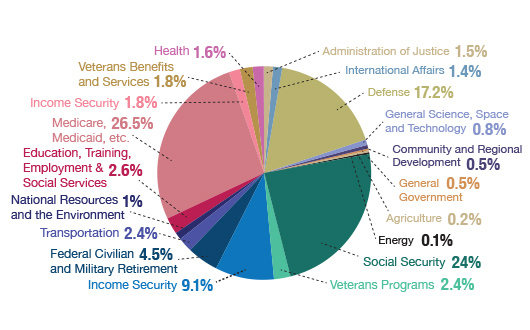
Every year we pay our taxes. Where does that money go and why? In 2014, as in recent years, Americans will spend more on taxes than on groceries, clothing, and shelter combined.  So what do all those weeks of work get us?

In 2014 the $3.5 trillion federal budget for 2014 can be broken down into major categories. The biggest category is Social Security and income programs, which uses 24% of the budget.  Another 17% of the budget goes to defense and related items, and 26% goes to Medicare and health programs. The other 33% of the budget pays for the following categories:

  • Veterans' Benefits
  • Education, Employment, Training & Social Services
  • Veterans' Services
  • Energy
  • Agriculture
  • General Government
  • Administration of Justice
  • Community & Regional Development
  • International Affairs 
  • General Science, Space, & Technology
  • Income Security
  • Federal Civilian & Military Retirement
  • Transportation
  • National Resources & the Environment
  • Income Security
  • Health

Are taxes one of your biggest budget items? If so, you should take steps to make sure you’re managing your overall tax bill. Please consult a qualified tax professional for specific information regarding your individual situation. 

The Tax Office, Inc., works with you to compile your records and file your taxes.  If there are any questions we can answer regarding how your tax money is used, or taxes, please contact us. Our tax specialists are happy to assist with any tax related matters.


Topics: Jenny Shilling, taxes

Tax Deductions for Landords

Posted by Keith Huggett on Fri, Aug 1, 2014 @ 07:08 AM

A Deductions Checklist...

real estate deductions, landlord deductionsAuthor: Keith Huggett

Many people, including real estate professionals,  don’t fully appreciate just how much money they can save with tax deductions.  Almost everything you buy for your real estate business is tax deductible as long as it is ordinary and necessary and the cost is reasonable. These deductions can really add up as savings for your business. There are dozens of possible tax deductions for real estate professionals.

  • Advertising – The costs of signs and advertisements for the rental property.
  • Auto – Landlords are entitled to a tax deduction whenever they drive anywhere for their rental activity. Keep a mileage log to track your starting location, destination, purpose, and mileage. Using a mileage app on your smart phone can simplify this task.
  • Depreciation –  Landlords get back the cost of real estate through depreciation. This involves deducting a portion of the cost of the property over many years.
  • Equipment / Computers / Furniture – These items are only deductible to the extent used for business. These are capitalized and deducted through depreciation over time.
  • Home Office – Working from a home office allows you to deduct a portion of your home mortgage interest, homeowner’s insurance, utilities and property taxes toward your rental business. This is true whether you own your home or apartment or are a renter.
  • Home Owner’s Association Dues – HOA's often charge association dues.  These dues are used to provide maintenance services for the home owners.  Renting out your property makes these fees deductible for rental activities.
  • Interest – You can claim the mortgage interest paid on loans used to acquire or improve rental property and interest paid on credit cards used to purchase goods or services used in a rental activity.
  • Insurance – You can deduct the premiums you pay for almost any insurance for your rental activity. This includes fire, theft, and flood insurance for rental property, as well as landlord liability insurance.
  • Lawn Service / Pest Control / Carpet Cleaning – The cost of services not paid for by a tenant are deductible.
  • Professional Fees – Any costs you pay to an attorney for eviction, a management company, engineer or CPA, etc. are deductible as they relate to the rental business.
  • Repairs – Repairs may be expensed (deductible this year) OR capitalized and depreciated (deducted over many years) depending on the size and nature of the expenditures. There is a difference between making repairs and making improvements on your home.
  • Telephone – Only the business portion of your phone usage is deductible.
  • Utilities –  If utilities not paid by the tenant, these costs can also be deducted.
Keeping records for these deductions is critical.  Without them it would be difficult to prove to the IRS why these deductions were claimed. The Tax Office, Inc., can assist you in compiling rental real estate data and reporting the information on the appropriate lines of the appropriate forms so you can claim your rightful deductions.

Topics: Keith Huggett, tax deductions, real estate

4 Tips for Documenting your Business Expenses

Posted by Jenny Shilling on Tue, Jul 29, 2014 @ 10:07 AM

Prove Your Deduction Claim When the IRS Comes Calling.

tax records, record keepingAuthor: Jenny Shilling

Keeping good records is critical. Should the IRS come calling, you will have the documentation you need to prove that your deductions are correct.  Keeping proper records will also make your qualified tax professional very happy, as it makes their job a little easier.  Expenses that are "ordinary and necessary" can be deducted if you have the correct documentation.  Here are 4 tips for what constitutes correct documentation:

  1. Cancelled Checks - A canceled check can be used as proof of payment if it has the name of the payee and shows the cancellation on the back. The IRS will also accept digital images of your checks if your cancelled checks are not returned to you.
  2. Credit Cards, Debit Cards & Electronic Funds Transfers - Your credit card statement must shows the amount of the charge, the transaction date, and the name of the payee to be acceptible proof.
  3. Invoices - You must have an invoice or some other form of documentation showing what you purchased. Canceled checks, credit/debit card statements, and records of electronic funds transfers only provide proof that you made a purchase.
  4. Cash register receipts. If you receive a receipt with no details of the items purchased, write a description of the items on the slip. To prevent deterioration of cash register receipts, consider using your smart phone and a record keeping app to save proof of those receipts.

When gathering your documentation, be sure to indicate the business reason for your purchase on the invoice or receipt so you’ll be prepared for any questions from the IRS. Keeping your documentation stored in the cloud makes organization easier. With all of the records easily accessible from one location, they can be uploaded or sent to your qualified tax preparer through the use of email or portal access.

The Tax Office, Inc., works with you to compile your records.  If there are any questions we can answer regarding record keeping, storage or taxes, please contact us. Our tax specialists are happy to assist with any tax related matters.

Topics: Jenny Shilling, record keeping